Response to Lawsuit over Trump EPA’s Failure to Protect Communities from Trash Incinerator Pollution
Lawsuit arrives as Minneapolis community marks one month since hunger strike demanding county action to close HERC incinerator.
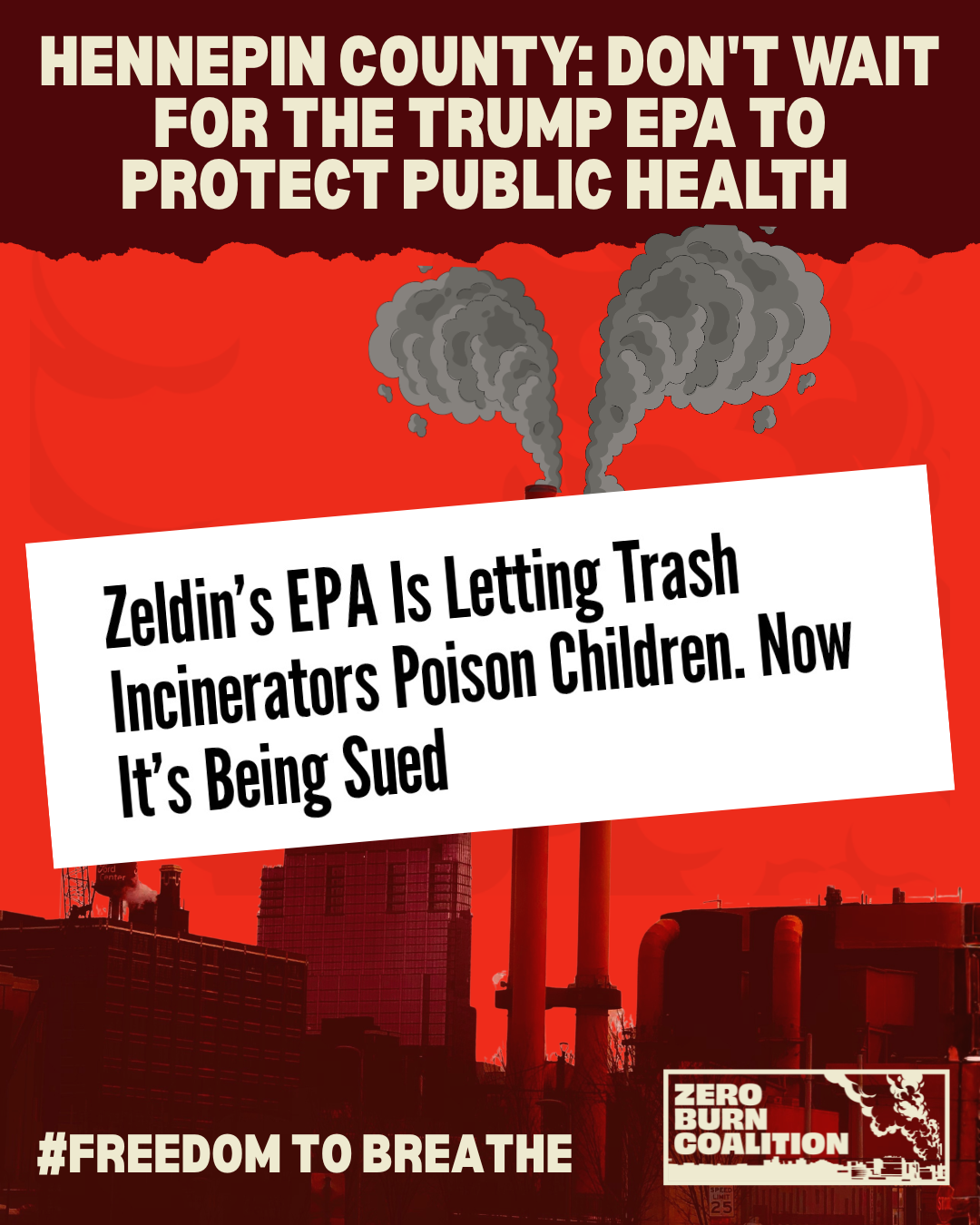
MINNEAPOLIS -- Earthjustice and the Environmental Integrity Project filed suit against the U.S. Environmental Protection Agency this week, arguing that the federal government has defied the Clean Air Act by setting emission standards for municipal trash incinerators far weaker than the law requires and far weaker than what modern pollution controls can achieve -- and that the Trump EPA has no plans to change that. [READ: Zeldin’s EPA Is Letting Trash Incinerators Poison Children. Now It’s Being Sued]
The HERC MPCA permit that County Commissions and staff have lauded as proving it is safe was found in 2008 to be faulty under the Clean Air Act. Improvements ordered by a federal court were finally proposed by the U.S. EPA in 2024 and would have dramatically reduced harm from incinerators for particulate matter (PM) and ozone alone by an average of about $12 million per year. But the Trump Administration watered them down.
The lawsuit names mercury, lead, arsenic, and dioxins -- cancer-causing pollutants with no safe level of exposure -- as documented harms being absorbed by communities living near these facilities. It calls what is happening a failure of law, a failure of regulatory will, and an environmental justice crisis.
The Minnesota Environmental Justice Table says the lawsuit describes exactly what Minneapolis has experienced for 37 years at the HERC trash burner.
Nationwide, nearly 8 in 10 trash incinerators are located in Black, Indigenous, and low-income communities. The HERC trash burner sits in Minneapolis, a five-minute walk from Heritage Park in North Minneapolis, next to Target Field, near several homeless shelters and schools -- and is an unwelcome surprise to residents of new developments in the North Loop who may not have known what was burning nearby. Its pollution doesn't stop at the fenceline. The facility's emissions affect neighborhoods across Minneapolis, falling hardest on those closest to it.
Nearly one month ago, Natasha Villanueva, Joshua Lewis, and Nazir Khan ended a 12-day hunger strike after the Hennepin County Board refused to call a vote on closure. On Day 12, Khan stood before the Board and read from a national letter drafted by The Ecology Center in Michigan and endorsed by more than 100 organizations, including almost every major environmental justice (EJ) organization in the United States: "Across the United States, the fight against waste incineration has become one of the defining environmental justice battles of our time…You cannot claim climate or racial justice leadership while continuing to operate the county's largest polluter. You cannot claim to be progressive while allowing Black, brown, and immigrant communities to continue bearing the burden of this pollution. Your continued support for incineration is not a progressive position."
"What Earthjustice is arguing in federal court is the reality people in Minneapolis have been living since 1989," said Khan, co-founder and Executive Director of the Minnesota Environmental Justice Table. "Federal regulators failed these communities. Now a federal court will hold them accountable. Hennepin County doesn't have to wait for a court order. The Board has the power to act today. Every day they delay is another day our neighbors pay with their health."
Independent scientific analysis by former EPA risk assessment scientist Doug Gurian-Sherman found that communities closest to the HERC trash burner face several times higher cancer and non-cancer risk than those farther away -- a finding the county had buried in its own data. A forthcoming report from Gurian-Sherman will identify significant methodological flaws and likely harmful PFAS “forever chemical” emissions in a recent engineering study commissioned to assess incinerator emissions, raising additional serious questions about whether regulators have ever had an accurate picture of the harm this facility is causing.
The HERC trash burner is the biggest polluter and single largest source of nitrogen oxide pollution in Hennepin County, responsible for 25 percent of county NOx emissions across 223 facilities. Independent analysis estimates the burner causes at least 1-2 premature deaths per year and at least $24 million in annual health damages from particulate emissions alone.
"Leadership means refusing to hide behind weak federal standards -- especially those shaped by the Trump EPA. If Hennepin County truly believes in protecting its residents and advancing racial and environmental justice, it must act now to close the HERC trash burner. Waiting for the Trump administration is not leadership. It is a failure of responsibility. Our communities deserve bold, immediate action that puts their health and well-being first." said Khan.
###
About Zero Burn Coalition & Minnesota Environmental Justice Table
The Zero Burn Coalition represents more than 70 organizations convened by the Minnesota Environmental Justice Table (MNEJT) and working to shut down the HERC trash burner and build the zero-waste future that HERC blocks. MNEJT has a record of winning: it helped build the Frontline Communities Protection Coalition and lead passage of Minnesota's landmark 2023 Cumulative Impacts Law, which requires the state to account for the compounding pollution burdens carried by frontline communities. MNEJT successfully advocated to remove HERC's recovered energy from being counted as renewable in the 2023 100% Clean Electricity Law. It blocked $26 million in state funding for a Dirty Materials Recovery Facility (Dirty MRF) in Brooklyn Park that would have burdened another working-class community of color and that the County was pushing for with no community engagement. It is currently developing legislation to strengthen landfill standards -- requiring stronger emissions monitoring, methane capture, and groundwater protections. Through the Minnesota Zero Waste Coalition, MNEJT has helped lead policy development on organics diversion, extended producer responsibility, and reducing single-use plastics, building the upstream systems that make a Zero-Waste future possible.