Zero Burn Coalition Launches Campaign to Hold County Commissioners Accountable to Closing HERC, Building On Hunger Strike
With hunger strike successfully exposing Commissioners’ lack of intent to shut down HERC, Zero Burn Coalition announces district organizing process leading up to June County Convention
While County Commissioners ignore constituents & science and refuse to hold required vote to shut down HERC, elected leaders in City Council, legislature commit to action to close HERC
HENNEPIN COUNTY – After “Freedom to Breathe” hunger strikers put their bodies on the line in their fight to shut down the Hennepin Energy Recovery Center (HERC), the largest industrial polluter in Hennepin County, the Zero Burn Coalition has announced the end of the hunger strike and launched the next phase of their campaign to hold County Commissioners accountable for their unwillingness to take action and close HERC.
The hunger strike, which lasted from April 10 to April 21, succeeded in setting the record straight with the general public: County Commissioners have the power to close HERC but for years have misconstrued their efforts to do so. The strike proved that Commissioners have no intent to shut down the incinerator and refuse to hold the necessary vote to initiate its closure. Adding to this, County Commissioners continue to shift responsibility of Zero Waste to Minneapolis, despite the City being the biggest driver of Zero Waste in the state.
In stark contrast, elected leaders in the Minneapolis City Council and the Minnesota legislature showed strong support for the hunger strikers’ mission and, coming out of the strike, committed to getting Hennepin County to the table to close HERC once and for all.
"Twelve days without food, and we finally sat face to face with the County board for the first time in Monday’s Board meeting,” said Nazir Khan, executive director of the Minnesota Environmental Justice Table, hunger striker, and Whittier neighborhood resident. He describes the strike as “forcing a reckoning,” and emphasizes the coalition is not done. “Dozens of organizations across the United States stepped up in solidarity with us. The community showed up. The evidence is clear. The only thing missing is a vote — and we will not stop until we get one."
Phase Two: The Fight for Accountability
Building on the momentum of the hunger strike, the Zero Burn Coalition’s next phase will focus squarely on holding County Commissioners accountable for failing to close the HERC and protect public health. This includes a series of district-based town halls for constituents to share their stories living in the neighborhoods surrounding HERC and national climate experts to address the incinerator’s public health risks; and public scorecards of Commissioners, assessing their engagement on climate and environmental justice and efforts to shut down HERC all in advance of the Hennepin County Convention on June 13.
“We've met with representatives from all levels of government, faith leaders, students, journalists, and constituents — all calling in one voice to shut down the trash burner. And yet, our County Commissioners have mischaracterized us as aggressive and being in the pocket of landfill companies, all for raising awareness around this issue and asking for accountability from our own elected officials who we chose to represent us," said Natasha Villanueva, Jordan neighborhood resident and hunger striker.
“While the County has the power to shut down HERC, the reality is that we hold the power to elect our Commissioners. Leading up to the County Convention, their constituents are paying attention, and we will be evaluating them on their commitment to environmental justice and shutting down this dangerous facility,” said Villanueva.
"The 2028 to 2040 range is a PR stunt,” said Khan. “It sets impossible conditions for closure — requiring Minnesota to reach 100% renewable energy, the county to reach 85% recycling, which no municipality in the world has yet reached, and no increase in landfilling. This no increase in landfilling is a PR trick meant to appeal to environmentalists — but Sierra Club North Star Chapter, Minnesota Center for Environmental Advocacy (MCEA), Black Visions, Health Professionals for a Healthy Climate (HPHC) were not swayed."
Speaking on behalf of the Sierra Club North Star Chapter's 14,000 Hennepin County supporters, Deputy Director Mary Blitzer called on the board to act without further delay, "It is time for us to stop asking more moms and dads and kids from north Minneapolis and surrounding neighborhoods to bear the cost of burning the trash from across the county. Set a shutdown date. Accelerate our move to zero waste.”
Public Health & Science On the Line
The fight to shut down trash incinerators remains a nationwide public health fight. In Miami, residents are currently demanding legal justice in the courts after facing widespread health consequences stemming from their local incinerator. In Philadelphia, local electeds are debating whether to extend the City’s contracts with the incinerator amid growing health concerns.
In Minneapolis, the HERC trash burner has operated in a densely populated, majority-Black neighborhood between Downtown and North Minneapolis since 1989, or 37 years. That’s 17 years beyond HERC’s design life. While HERC remains open, EPA modeling links it to 1–2 premature deaths and $11–24 million in annual health damages each year from particular matter emissions alone. Children in ZIP code 55411 go to the emergency room for asthma at among the highest rates in Minnesota.
“County Commissioners and staff continue to claim that HERC’s emissions are safe because the emissions are below their permit limits. To be clear: the permit is outdated, not based on health standards, and missing key pollutants. We have directly communicated this to Commissioners but these harms are willfully ignored,” said Dr. Leslie Myint, Associate Professor of Statistics and Data Science at Macalester College with a PhD in Biostatistics from Johns Hopkins University.
While County Commissioners continue to ignore the data, they also remain firmly against the temporary increase in landfill use. In contrast, Zero Waste USA’s 2023 HERC Transition Plan finds that closing HERC alongside a temporary increase in landfilling would enable the county to accelerate progress toward zero waste. Incineration is widely recognized as a barrier to waste reduction, as it depends on a steady stream of trash to remain financially viable—undermining recycling and composting efforts. In fact, incinerator closures have created urgency and driven investment across the county to accelerate waste reduction and recycling.
Detroit’s recycling rate doubled after its incinerator closed in 2019. Hennepin County itself forced Minneapolis in 2014 to launch its current city composting program after a community effort blocked the county from burning 20% more trash at HERC.
“Although every successful incinerator closure in the country has used landfills as a temporary bridge while zero waste infrastructure is built, Commissioners express vehement opposition to any increase in landfilling. They provide no evidence to support their position, which stands in contrast to findings from multiple studies comparing the health and environmental impacts of incinerators and landfills across the country,” Dr. Myintadded.
The Coalition Brought the Fight on Multiple Fronts
Over the course of the 12-day hunger strike, the coalition received widespread support from elected officials, community leaders, health professionals and more.
On April 7, at the Minnesota legislature, the Zero Burn Coalition joined the People Over Polluters oversight hearing to hold the MPCA accountable for its failure to protect Minnesotans from pollution harm. At the hearing, the groups advocated for HF 4197 / SF 4578, the HERC Accountability Act authored by Rep. Fue Lee, while opposing HF 1473 / SF 1250, Hennepin County's bill to spend $26 million in state funds on a dirty Materials Recovery Facility in Brooklyn Park with no meaningful community process.
At an April 15 press conference, faith leaders from across the Twin Cities issued a direct call on commissioners to come to the table and end the hunger strike, connecting the moral obligation to act to a tradition older than any policy debate: no community should be made a sacrifice zone.
On April 16, health professionals from the Minnesota Nurses Association, Health Professionals for a Healthy Climate, Health Students for a Healthy Climate, and Minnesota Doctors for Health Equity held the public health forum that Commissioner Conley, Chair of the Hennepin County Health Committee, has refused to convene. At the forum, health professionals presented data about the harms of HERC and made clear that many preventable hospitalizations land at HCMC, the hospital that doesn't turn people away.
At HCMC, 48 percent of patients are on Medicaid, and the medical center absorbs 20 percent of all uncompensated care in the state of Minnesota. Closing the HERC trash burner is upstream healthcare. Fewer asthma attacks in ZIP code 55411 means fewer uncompensated ER visits at the only institution built to catch the communities the system otherwise abandons.
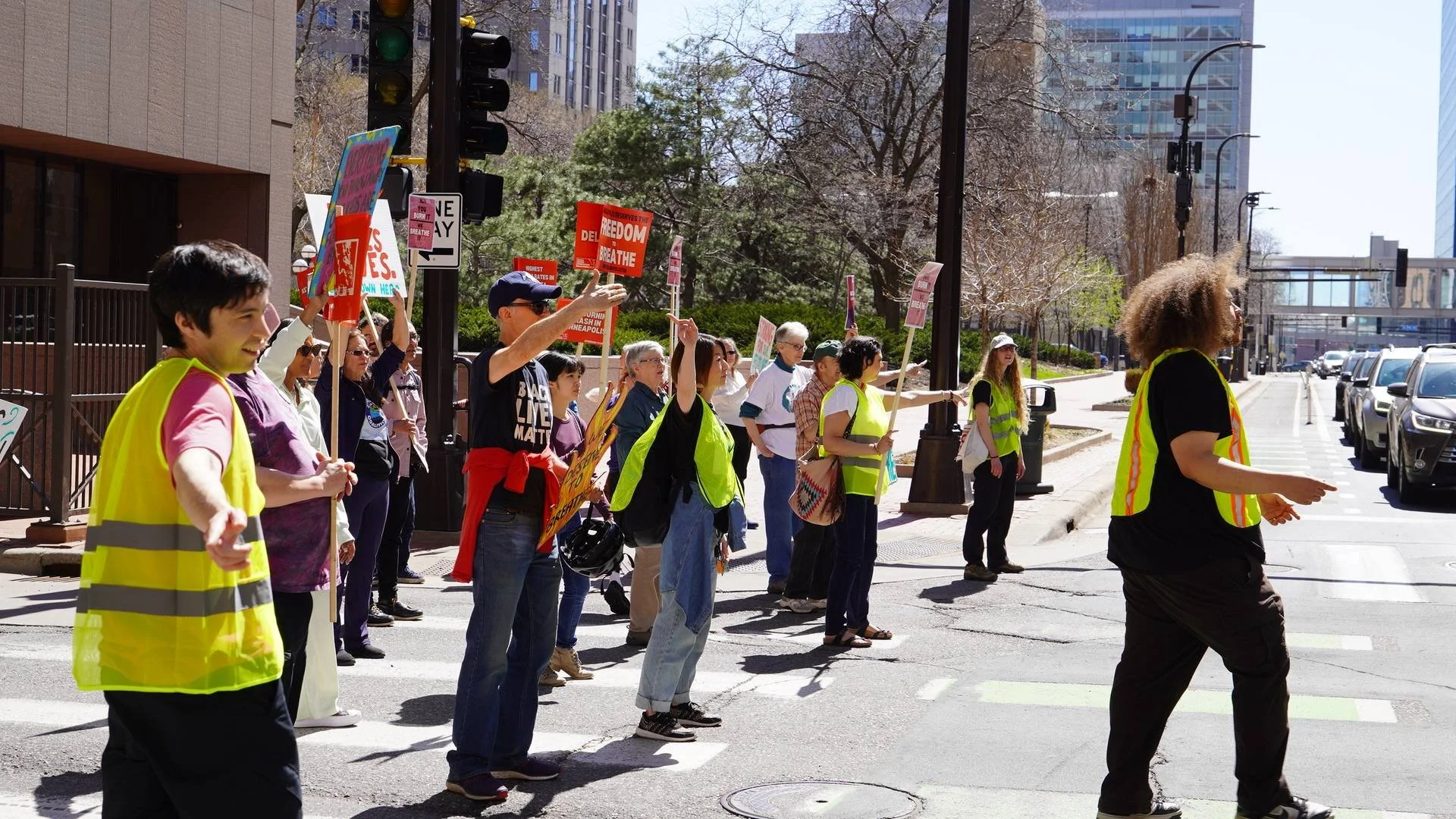
On April 18, community members marched to the HERC trash burner and picketed at its fence line — standing at the source of the harm, in the neighborhood that has absorbed it for 37 years.
The following day, the coalition convened a cross-metro discussion connecting people fighting in sacrifice zones across the region, building solidarity across movements and making clear that the fight to close the HERC trash burner is part of a broader struggle for clean air and environmental justice throughout the Twin Cities.
On the final day of the hunger strike, strikers and allies attended the County Board meeting to deliver public comments and directly call on Commissioners to set a vote on closure. Noticeably, Commissioner and Chair of Hennepin County Health Committee Angela Conley was absent from this part of the meeting. After public comment concluded, coalition members began singing in the chamber in solidarity. In response, Commissioners immediately exited the room, continuing a pattern of avoiding direct engagement with constituents demanding action on HERC’s health impacts.
Throughout the strike, the campaign's digital organizing reached 170,000 Hennepin County residents across Districts 2, 3, and 4 — the constituents of Chair Irene Fernando, Commissioner Marion Greene, and Commissioner Angela Conley. Additionally, the Zero Burn Coalition chapter at the University of Minnesota grew significantly during the strike, with students hosting teach-ins and a press conference demanding their own commissioner, Angela Conley, listen to constituents and act.
About Zero Burn Coalition & Minnesota Environment Justice Table
The Zero Burn Coalition represents more than 70 organizations convened by the Minnesota Environmental Justice Table (MNEJT). MNEJT has a record of winning: it led passage of Minnesota's landmark 2023 Cumulative Impacts Law, which requires the state to account for the compounding pollution burdens carried by frontline communities. MNEJT successfully blocked HERC's energy from being counted as renewable under Minnesota's 100% Clean Energy Law. It is currently advancing legislation to strengthen landfill standards — requiring stronger emissions monitoring, methane capture, and groundwater protections — to ensure that closing the HERC trash burner does not simply shift harm to another community. Through the Minnesota Zero Waste Coalition, MNEJT has led policy development on organics diversion, extended producer responsibility, and reducing single-use plastics, building the upstream systems that make a zero-waste future possible.
Learn more: zeroburncoalition.org
###